Sunday, January 1, 2012

Julian Barnes writes a thoughtful novella.

I have enjoyed Booker-prize-winning Julian Barnes in the past, and I was delighted to read his latest novel. Its winning the 2011 Man Booker Prize only made it more delectable.


The Sense of an Ending

The Sense of an Ending (176 pages, Knopf, $23.95) takes the form of a ruminative memoir. I called it a novella above because it has the shape of something briefer than a novel, almost a long short story. That’s in part because it has a moral twist of an ending that reminds the reader of some of the best American short stories. Barnes perhaps over-invests his shocking ending with explanatory power. What is really powerful is everything that comes before the ending.

Like many British memoirists, the hero, Tony Webster, ruminates over relationships in so-called public school. Tony has two close friends at school, and they are smart enough to spend their time “taking the piss” out of their teachers and putting up their noses at the whole idea. Then along comes Adrian Finn, and they find themselves rethinking their position. They can never tell whether the brilliant Adrian is taking the piss or not.

Tony is especially fascinated with Adrian, and he spends time spinning out his ideas from memory, as he looks back after forty years. He also looks back on his frustrating and only semi-fulfilling relation with a enigmatic girl called Victoria. Even when he breaks up with Victoria, he is not sure where he stands with her. He almost seemed to get along better with her mother than he did with her.

Imagine his surprise, then, when Victoria’s mother leaves him a small legacy after her death thirty-some years on. After Tony broke with Victoria, she took up with Adrian, and at the time of their marriage, he wrote them both off as lost causes.

In the ensuing years, Tony had a successful, if uneventful, life. And now that he has to confront the past once again, because of the particular nature of the legacy, Adrian finds himself swept up in emotions that he thought he had put to rest.

As Tony tries to pry some secrets out of Victoria and confront his own earlier emotions, all his suppositions collapse and he finds himself confronting features of the past quite different from those he has constructed for himself.

This is exciting, in its way, and it does show Barnes at his most subtle and sophisticated. I enjoyed the novel a lot, but I think the plot would have made a great short story too.


Julian Barnes

The Sense of an Ending is available at Powell's, Vroman's and Amazon.

Saturday, December 17, 2011

The Paul Scott saga does not show its age.

I am continuing with my reading of The Raj Quartet. These novels are as compelling now as they were when they were first published.


The Day of the Scorpion

Paul Scott’s The Day of the Scorpion (292 pages, University of Chicago, $22.50), the second volume in The Raj Quartet, deepens and intensifies matters that were raised in the first volume.

Daphne Manners has died and her mixed-race daughter has been taken in by her mother, the elusive Lady Manners. Lady Manners, for this claiming of the child and for her other eccentricities, is labeled an outcast by the English culture of India. She seems unaffected by this judgment and seems to circulate in a world of which these other English women are unaware.

A new family that comes into our ken is the Layton family. The father of this family is in a German prisoner-of-war camp, and the mother is in India with her two daughters, both of whom have grown up on the subcontinent. Sarah, the elder of the two, is plainer and more intelligent, than her bright, pretty, and unstable sister Susan. When making her way to her family’s station, Sarah finds herself in a houseboat next to that of Lady Manners. She secretly makes an acquaintance of that lady and finds that there is a true sympathy between them.

We also meet Mohammed Ali Kasim, a senior Moslem political figure who has been working for Indian national unity. He is one of the figures who was arrested on the night of the violence in volume 1, and we now hear his story and begin to understand more of the political implications of those arrests and the status of Indian independence in the middle of World War II.

Also, we have occasion to meet up with Hari Kumar in prison. Lady Manners has arranged to witness an interview in order to help her determine whether he is the father of the child that Daphne has left behind. No one knows the truth of what happened that night—no one now except Hari Kumar himself—but he still protects those intimate details from the prodding of even these sympathetic questioners.

All these threads are woven together as Susan Layton marries Teddi Bingham, and Gordon Merrick emerges as her husband’s off-hand choice of a best man. Merrick's motivations are reviewed once more—he is his own worst enemy for in defending his own actions, he digs himself into a deeper hole of ignominy. It only gets worse when, shortly after the marriage, he and Susan’s husband Teddie go off together on a military exploit at the Burmese border and Teddie is killed. Merrick himself is maimed—he is burned badly and loses an arm—but when Sarah visits him to convey her sister’s thanks for helping her wounded husband, she is upset to recognize the degree to which he gives her the creeps.

For me, Merrick is a weak link in the novel. He is so bad to be almost unbelievable. And he is “bad” first of all because we recognize his suppressed homosexuality and secondly because he is so clearly marked by class. I think it is far too easy for Scott to make the lower class queer the source of everything that is wrong about the British Indian empire. But he knows it is not that simple and the novel makes it clear that he sees further complications.

This volume ends powerfully and provocatively. Susan barely survives giving birth to a boy, and Sarah feels that her own life has changed almost as profoundly. Prisoners are being released and there seems some chance that England is being pushed toward an end-game in India. How that is worked out will be the subject of the next two volumes.


Paul Scott

The Day of the Scorpion
is available at Powell's, Vroman's and Amazon.

Saturday, December 10, 2011

Iris Murdoch writes a grim but engaging urban tragedy.

I said I would read a few more Murdochs, and this one is as great and even more chilling than the others I have read.


The Black Prince

Iris Murdoch’s The Black Prince (408 pages, Penguin, $16) was first published in 1973. It tells the story of Bradley Pearson, a well-respected but little-published writer who has resigned his position on the Tax Board in order to write full-time.

Bradley is in a sort of competition with his friend Arnold Boffin, a much more prolific writer who has dozens of titles in print and a great deal of public accolades. Arnold is married to Rachel, and early in the story Bradley is called in when Rachel has been injured. But it turns out that Arnold had belted her with the fireplace poker, and Bradley is deeply concerned for her safety.

Soon after the novel opens, another woman appears on the scene. This is Bradley’s ex-wife Christian, who has returned from a sojourn in America, where she lived with her second husband and managed to amass a great deal of wealth. Bradley hates her, but she seems determined to get back into his good books, and she does everything she can to get him to admit that he would like to be friends again.

Other characters include Francis, Christian’s feckless brother, who also seems committed to bring the formerly married couple together; Priscilla, Bradley’s sister, who leaves her husband Roger just as the story begins and moves back and forth between Bradley and Christian, who likes her and wants to help her. There is also Julian, an androgynous teenager, the daughter of Arnold and Rachel, who is fascinated with Bradley and asks him to give her lessons to help her become a writer.
All these characters stir a rather rich and wonderful brew. Bradley is narrating, and his ability to capture his emotional responses to people is deeply impressive.

As he is busy fighting off Christian’s well-heeled assault and Rachel’s tears—Rachel has made her love for Bradley clear almost from the first—and Priscilla’s whining about the things she left at her husband’s home, Bradley falls deeply in love. This state of being in love is simply sublime, but the implications are horrific because he is in love with the only sixteen-year-old Julian. Bradley is fifty-eight.

At first Bradley isn’t going to tell Julian anything about the love he feels for her. It is something precious and all his own, and she need never know. But of course he is about to explode with his feelings, and when he finally does talk to her about his love, after an aborted attempt to listen to Der Rosenkavalier at the Royal Opera, she does not seem as immediately put off as he expects her to be. In fact, she seems willing to return his love.

When she does, and when she announces this love affair to her parents, well, needless to say, all hell breaks loose.
The last section of the novel is an extended battle between Bradley and Julian’s parents, and to say it ends badly is a ridiculous understatement. What is clear is that everything is culturally conditioned to forbid a relationship like the one Bradley and Julian are trying to establish and they fail. In fact they fail miserably, and Bradley pays the price for being willing to try to establish such a relationship in the first place.

The story ends unhappily, but there are various post-mortems that try to make more sense of it. Even they fail, and at the end the reader has to wonder what it has all been about.


Iris Murdoch


The Black Prince is available at Powell's, Vroman's and Amazon.

Sunday, November 27, 2011

Paul Scott’s Raj Quartet after twenty-five years

I am teaching a class on E. M. Forster this term, and after reading his wonderful A Passage to India, I decided to look at these novels from the 1960’s that were inspired by Forster’s masterpiece.


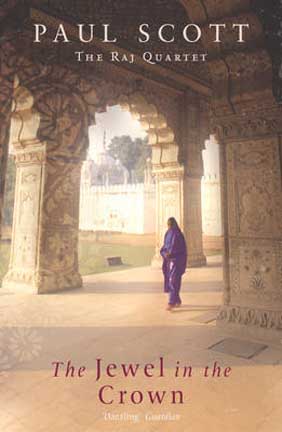
The Jewel in the Crown

The Jewel in the Crown (462 pages, University of Chicago, $20) is the first book in Paul Scott’s majisterial Raj Quartet. First published in 1966, the novel looks back to the twilight years of the British colonial presence in India. Set in 1942, although it moves earlier and quite a bit later than this year, it tells the story of the incarceration of Indian political figures encouraging resistance to the British colonial rule, which results in several disturbing events that are told in intimate detail.

The first shocking tale is that of Miss Crane, a single English woman who settled in India as a teacher after being taken there as a governess in the employ of upper-class English civil servants. Miss Crane has been a wonderful pro-Indian teacher and worker, but even she feels the strong divisions of colonial rule. On the day when politicians are put in jail, rioting in the countryside catches Miss Crane off guard, and she and her Indian assistant are attacked by a mob. She survives, but the assistant is killed and Miss Crane sits with him in the rain until help arrives.

Miss Crane has a complete breakdown after this attack, feeling primarily that she let her assistant down. She loses her mind imagining that she could have done more to make the connection to the native population.

Miss Crane is a fitting character with which to begin this complex novel. She stands for all that is wrong with even the most well-meaning of the colonial power.

More riveting, in part because told from so many different angles, is the love affair between Daphne Manners, an orphaned English girl staying with a Brahman lady in the fictional Mayapore, and Hari Kumar, or Harry Coomer, the young Indian man who has been brought up in England and come through the public school system. This love affair is a tragedy by definition because of the racial and cultural differences that the two characters would have to overcome. Even their friends can hardly trust these two characters together. It simply isn’t done.

Far worse, though, is the mad and simmeringly homoerotic jealousy of Gordon Merrick, a local policeman, who himself proposes to Daphne and looks at his competition with a form of loathing desire. Needless to say this makes him sadistic in his prosecution of Hari when Daphne has been raped and it seems that Hari might well have been involved.

Scott tells this story with exhilarating narrative technique, which involves transcripts and interviews with almost all the central characters, some of whom are wonderfully colorful in their own right. And while he tells this story of sex and victimization, he also analyzes the presence of the British in India at the end of the Raj as few other writers have been able to do.

The Raj Quartet is a masterpiece, and The Jewel in the Crown is its wonderful beginning. I will reread all four novels in time, but I cannot promise to review then all at the same time.


Paul Scott

The Jewel in the Crown is available at Powell's, Vroman's and Amazon.

Sunday, November 20, 2011

Alexander Maksik tells a depressing tale in an exciting way.

Alexander Maksik writes about high school, but his school is an international high school in Paris, and that changes everything, or does it?


You Deserve Nothing

The story of You Deserve Nothing (320 pages, Europa Editions, $15) centers on a charismatic high school instructor who teaches the choice senior seminar at the international high school in Paris. All the students are in Paris for various reasons, and they are more or less unhappy with their lot; but when they find themselves in Will Silver’s classroom, their lives change. They are exhilarated and they find that they are able to think in ways that they never realized that they could.

Will is great at bringing them out of themselves and giving them new voices by forcing them to articulate their own ideas. Maksik’s depictions of the classroom itself are really wonderful because it is possible to feel the productive tension that Will creates with these students.

We also get to know the different students and care about them: Gilad, the smart but reserved American who never feels quite at home; Colin, the Irish brat who is sometimes willing to challenge Will to his face; Ariel, a fashionable girl who has to be cured of her tendency to say “whatever”; and Abdul, an Arab student who has a hard time with the other students’ carelessness about God and the meaning of life.

Will manages to keep all these competing interests afloat and even to fight off the administration’s pressure to conform to the standard syllabus of high school literature classes. But instead Will wants to challenge his students, and they love him for it.

But in the end Will screws up, and he is dishonest both to himself and his students. He has an affair with a girl at the school. Admittedly she is not in his class, but she is underage, and she is also friends with Ariel and a former girlfriend of Colin’s; so there is little chance that this “secret” affair does not actually spill into his classroom.

Will is distraught about the affair, but he has it anyway, and Maksik is good at portraying the misery that attends such misguided sexual license. We also hear a lot from the young girl’s perspective. Marie has her own motivation and her deep feelings for Will, but she does not know anymore than he does what the consequences of their behavior will be.

Maksik is great at bringing out the disillusionment that all the students feel when Will Silver is exposed. He is also great at portraying Silver’s own misery. Sad, too, is the demise of the wonderful class where students were actually challenging their own limitations. But that starts to lose significance when their teacher turns out to be a louse.


Alexander Maksik


You Deserve Nothing is available at Powell's, Vroman's and Amazon.

Sunday, November 13, 2011

Michael Ondaatje’s WWII masterpiece can prepare us for his new novel.

When I heard that Michael Ondaatje had written a new novel, I thought it high time to go back and read his 1992 masterpiece.


The English Patient

The English Patient (302 pages, Vintage, $15.95) is a beautifully written and provocative account of a few lost characters surviving at the end of World War II in a former convent, near Florence, that has been a hospital but is really noting more than a shell.

Among the chief inhabitants of this building are the English Patient himself, a burn victim, whose story gradually emerges as the novel unfolds. There is also a nurse, Hana, who has devoted herself to the care of this patient; Caravaggio, a maimed thief who has a thing for Hana but also keeps a respectful distance; and Kip, an Indian sapper, who is there to defuse the hundreds of bombs and booby traps left behind by the Germans.

Ondaatje turns this only mildly promising material into a beautiful story of love and loss that gives poetic seriousness to the cost of war, a feat so few war novels are able to achieve.

The English patient’s need for constant care has meant that Hana has stayed behind when others have been moved to “safer” locations. Her devotion to the patient, and her careful cleansing of his hideous wounds, gives them an almost lyrical bond. She reads to him and feeds him fruit that she has sliced or sometimes even chewed for him, and he takes his care and nourishment not at all for granted. Instead he seems to know that he is lucky to have this attention.

Caravaggio does not like the patient—he resents Hana’s devotion to him—but he does not trust him either. And he starts on a campaign to discover who this mysterious man really is. While he starts laying traps in conversation and using other ploys to trick the patient’s memory, Hana draws back and unites with Kip, who brings a different ethos to this theater of war.

Kip’s deeply learned character and his commitment to defusing bombs make his a charmed figure in this no-man’s land. He gives it a kind of life that Hana clings to, and before long she and Kip are sharing intimate moments and interleaving their two lives.

As the novel draws to a powerful conclusion, the English patient’s secrets are revealed. While we hear of espionage and a destroyed marriage, on the one hand, Kip learns about the atomic bombs that were dropped on Hiroshima and Nagasaki. The explosive ending nearly destroys all those involved in this momentary idyll.


Michael Ondaatje

The English Patient is available at Powell's, Vroman's and Amazon.
Tuesday, November 8, 2011

Iris Murdoch creates a hero who is his own worst enemy, and that of a few others too.

After reading one Iris Murdoch, I had to read another. I found this one that I hadn’t read before, and I devoured it when I should have been doing other things.


A Word Child

In Iris Murdoch’s A Word Child, first published in 1975, Hilary Burde, an orphan who survived a brutal childhood to become an Oxford don and someone with a promising future, finds himself working for the Civil Service in a lowly position and looking back on all he has lost. At first we hear that something happened that made him leave Oxford, and before long we are wallowing in the hideous tale he has to tell.

Before we get there, though, we meet the people with whom he has filled his life. There is Christopher, his willowy and druggy young boarder, Tommy (or Thomasina) his erstwhile girlfriend, Clifford, a middle-aged homosexual who is in love with him, the Impiatts, Laura and Freddie, a senior colleague and his wife, Arthur, a junior colleague, and Hilary’s sister Crystal, an uneducated seamstress who lives in a single room and spends her days hoping to see her brother.

In typical Murdoch fashion, all these characters are rich and fascinating in their own way; but only when Gunnar and his wife Lady Kitty appear, as they do when Gunnar is to take over the Directorship of the office where Hilary works, do we get the full depth and desperation of the tale.

It seems that when they were both students at Oxford, where Hilary was a whiz in languages and linguistics, Gunnar, an older student and the first to win a fellowship to teach in the College, gave Hilary support in his attempts to move ahead in the college. As Hilary is being entertained by Gunnar and his wife, Anne, however, he finds that he is falling in love with the kind and supportive (and beautiful) young wife. The have an intense and very short-lived affair, and when he is trying to whisk her away, and she is begging to return to Gunnar, he smashes the car on the motorway, and she is killed.

To say that this has obsessed Hilary since it happened would be an understatement. It has completely destroyed his life—he resigned his fellowship and left Oxford immediately—but the way he sees it, it also destroyed his sister’s life. He had hoped to carry her along to higher things, and now he has just dragged her down into the dirt with him.

Now that Gunnar has arrived, what can he do. Is there any chance of forgiveness? Can someone who is not religious really repent? What does it mean to talk about the past, and does it continue to haunt you even after you have dredged it up to dissect it?

These are all questions that Murdoch addresses as she tells an amusing and tragic story about what happens to these people who are tangled up in love for one another. It is too shocking to say what happens to Hilary when he gets involved with Gunnar and Kitty, but suffice it to say that history almost repeats itself. But whether or not it does, Murdoch seems to insist, life still goes on and redemption can come where you least expect it. This is classic Murdoch.


Iris Murdoch

A World Child is available at Powell's and Amazon.