Sunday, September 25, 2011

Leslie Daniels writes a romance about Nabokov.

This novel was recommended to me probably because of the Nabokov connection. I enjoyed its playful approach to sacrosanct topics.


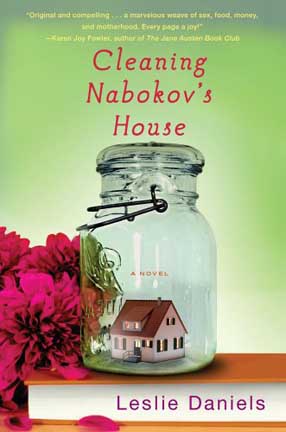
Cleaning Nabokov’s House


Leslie Daniels' debut novel, Cleaning Nabokov’s House (336 pages, Touchstone, $24), is an odd mixture of a work of literary fiction and an unadulterated romance. The heroine Barb, newly divorced, seems barely able to keep herself fed and dressed before she finds herself able to buy a house in an upstate New York college town, where she soon discovers an odd manuscript that might have been written by Vladimir Nabokov, who lived in the house while he taught at the College for a short time.

The manuscript, which is a kind of fantasy about Babe Ruth, fascinates Barb and starts to pull her out of her desperate funk.

She does not feel bad about choosing to leave her husband, but his well-connected local charisma allows him to keep her two children, and this drives her crazy. She is hoping that the money from the Nabokov might give her the money she needs to get her children back.

Of course, she also needs a stable home, and as she starts to come out of her depression, the home starts to feel anything by stable. For one thing, she decides, after a trip to New York where she sees the door of a notorious “cathouse,” to open a male brothel in her town. She poses as a sex-researcher, and gets local strapping college boys to function as her staff. Then she spreads the word for desperate housewives who would like a break in their daily grind. This male “cathouse” becomes so popular that she almost gets in trouble. Her few friends spend all their time urging her to be careful.

Meanwhile, she has fallen, romance-style, for a handsome and well-built local carpenter, Greg. Barb dates Greg gingerly, as if all men are poisonous; but at the same time she does want him to know about her brothel. This creates a bit of narrative amusement, and Daniels is good at playing these two plots against each other.

When the Nabokov connection falls through, Barb’s agent Maggie, the wife of another friend, urges her to try writing romance. She resists at first but gradually she gets the bug and starts to make a success of romance novel writing.

All this time, she is fighting to get her kids. Whether or not that works, when she is involved in running a brothel, is part of the delight of the book. The court-room battle between her and her ex-husband is one of the high points of the narrative.

Leslie Daniels has written an amusing first novel.


Leslie Daniels

Cleaning Nabokov's House is available at Powell's, Vroman's and Amazon.

Monday, September 19, 2011

Alan Hollinghurst captures the twentieth century in a masterpiece of literary recollection.

I have had an early look at this novel that has just been published in England, and I am going to write a longer review than usual.


The Stranger’s Child


Alan Hollinghurst’s The Stranger’s Child (448 pages, Knopf, $27.95) is a staggering accomplishment. It follows the fortunes of a couple of aristocratic families over the course of the twentieth century; and in doing so it raises issues about love and sexuality, memory, family, literary recollection, truth and falsity, bibliography, biography, English culture, war memoirs, and most important, perhaps, poetry and its relation to experience.

The story is told in several set-pieces, ranging from 1913 to 2008. Many of the same characters circulate in each of these pieces, but each features a new character and a new narrative perspective best suited to the historical moment being examined.

Each section of the novel is so riveting and so beautifully told that one could be forgiven for wishing that Hollinghurst had allowed himself to make an entire novel out of this setting or that historical moment. But in the end, it is perfectly clear that all these sections are necessary to tell the story that Hollinghurst is trying to tell. It is nothing less than a kind of cultural analysis of the twentieth century from a number of different perspectives.

At first the story might seem over-familiar. Two Cambridge undergraduates appear at one of their family homes during a vacation time. They are intellectually exuberant, each being a member of the Cambridge Apostles, a secret group that met regularly to discuss ideas and (it seems) to grope each other meaningfully. Cecil and George are in love with each other, and during their visit to George’s home “Two Acres,” they practically scandalize George’s sixteen-year-old sister Daphne, who always has a way of peeking through the hedge just when they are at their most intimate. Cecil Valence is handsome and muscular, and he is domineering as well. George, blond and handsome himself, is utterly smitten; and the two men can hardly keep their hands off each other at dinner or while lying in a hammock.

Meanwhile, Daphne is intrigued with Cecil too. She knows him because of the poetry he has published. He seems a close second to Rupert Brooke at the time—Hollinghurst publishes enough of Cecil’s poetry to allow us to judge for ourselves—and he has astonishing self-assurance. George and Daphne Sawle are caught up in this phenomenon, and both feel that the poetry he writes in Daphne’s autograph book—a poem called “Two Acres”—is meant for them. We have seen enough to know that the love for George was deep and meaningful to the poet but that his dalliance with Daphne—he kissed her in the entryway to the house—was vivid as well. It is fair to say that only George and Cecil know the depth of their shared love, and only they can read between the lines of Cecil’s most famous poem—which “Two Acres” quickly becomes—to understand how richly and fully it represents their love affair.

History, however, sees it differently. Cecil is killed in the First World War, and Daphne claims the role of the woman who was engaged to and now mourns him. It does seem that after the visit to the Sawle house, Daphne went to Cecil’s family house at Corley—a Victorian pile that fascinates her deeply—and that during those visits, apart from the constant carrying on of George and Cecil, she and the poet become attached. She has some love letters from France to prove her attachment. After Cecil’s death, however, she marries his dreadful brother Dudley. The second section of the novel is set in the 1920s, just before the General Strike in England. This is another moment when these upper classes are teetering on collapse. We see Daphne and Dudley at home. They are having a big weekend in celebration of Cecil, and we find other new characters and some of the old ones in new configurations. George is very much in the background here, and so is his mother. But she is carrying around with her a sheaf of letters that Cecil wrote George from France, the male love letters to contrast to those he wrote to Daphne, and she cannot decide whether or not to confront George with them. She is appalled at what they suggest and is clearly torn about what to do with them. We never discover exactly what happens to them, but we get the clear sense that they are lost.

We also hear at this time about some poems that Cecil may or may not have sent from France before his death. Some friends, and especially an early biographer, have seen these poems, but no one is sure what has happened to them.

These two threads—the letters that will tell a fuller truth about Cecil and George and the lost poems of Cecil—come to sustain the narrative, and in a sense we become like literary detectives ourselves, always hoping to get closer to these crucial details.

Throughout several later sections, as these central characters grow older and we meet their children and grandchildren, a young lower class guy, gay himself, gets to know that family and the house at Corley and becomes fascinated with the saga of Cecil Valence, a poet whose work he had to memorize at school. Paul Bryant, a bank teller in the 1960s, is a working biographer by 1980, and we see him trying to piece together the truths of George and Cecil and Daphne back in the teens. He meets the two survivors, the brother and sister who were both in love with Cecil, and talking to them he starts to make sense of the past. Both people are indirect and absolutely confusing when he talks to them, but he still starts to get something of the picture. He is a timid young man, and the sections of the novel in which he is central are among the most fascinating, both because he is an outsider to this upper-class world and because his own sense of himself and what he is trying to achieve is the most tentative.
In the last section of the novel, Paul’s biography has been long-since published, and we hear from various accounts how absurd the family considered it. Cecil was in love with George—what could be more ridiculous—and that Daphne has children outside of her (various) marriages, too. Paul is considered a rank intruder, but we know from our perspective that he has come close to the truth just through his amazing instincts and good guessing.

E. M. Forster is quoted here and seems to be the inspiration for some of the threads of the narrative, especially the early ones concerning the Cambridge Apostles, of which he wrote as well. Later sections, especially those with Paul as the narrative center, remind one most vividly of Henry James’s The Aspern Papers, which also concerned a young man trying to get to the heart of a writers identity. The Stranger’s Child pulls those traditions together, and also makes it clear how faulty memories of the past can be. The eighty-three year-old Daphne may think she is remembering the past, but as she even admits, she can hardly call to mind anything that ever happened after the cocktail hour—some sixty years all blend together in her memory—and who, she tells herself, even remembers anything they read.

This novel is about literature and memory, about attempts to make sense of the past, and how time itself obliterates much of what might in the past have been considered true. As the gay writer tries to get close to what happened in the past, he can only approximate what we ourselves have seen was immensely significant. Hollinghurst has told this story in order to make that fact of literary recollection vivid and meaningful to his readers. In this he has been preeminently successful. This is surely his own literary masterpiece.


Alan Hollinghurst

The Stranger's Child is available at Powell's, Vroman's and Amazon.
Sunday, September 11, 2011

Philip Kerr tells a very German version of World War II.

Philip Kerr has been compared to John Le Carre and Alan Furst. This is the first of his novels that I have read.


Field Gray


Field Gray (448 pages, Putnam, $26.95) is the seventh Bernie Gunther novel. Bernie is a non-Nazi German who is trapped and re-trapped in various mishaps before, during, and after the Second World War. Kerr uses him to offer a unique perspective on the conflict, and Bernie’s struggles tell us a lot that we might not have known about Germany, France, and Russia during the 1940s and 1950s.

As the novel opens, Bernie is picked up in 1954 when he is trying to help a young prostitute get out of Cuba. He is picked up by Americans and questioned about his connections to a much wanted East German, who was the head of the East German secret service, known as the Stasi.

In order to answer the demands of his peremptory interrogators, Bernie has to to reflect back on things that happened in Berlin in the early thirties, when he was a private investigator. At that time he came in contact with this figure, Erich Mielke, who is a committed communist in Wiemar Germany. As the Nazis start to come to power, Mielke becomes a hunted figure, and Bernie more than once finds himself in a position to help Mielke escape. Why he does this is only partly difficult to understand. Bernie sees Mielke as a kind of alter ego, and in a sense he envies him his deep belief in the communist ideal. Bernie doesn't really believe in anything.

Telling this story, in a rather disjointed and at times confusing way, takes us first through this thirties Berlin, and then, during the war, to France, where Bernie is sent to find Mielke, who is supposed to be a prisoner of war there. After a short time in occupied Paris, this is 1940, Bernie goes to the south to visit two prison camps there. The state of these camps and the cruelty of the French guards seems to be one of the points of Kerr’s narrative. More anti-Semitic than the Germans, Kerr seems to argue, these French functionaries were blood-thirsty and vindictive. When he spots Mielke in the crowds of impoverished prisoners, he refuses to point him out, in part because he does not want to play into the hands of the French.

Much later, Bernie finds himself in one horrifying Soviet labor camp after another. Now the question becomes one of mere survival, and the cruelty of the Russians now seems to be the main point of the narrative. Bernie escapes this horror, ironically, by means of Mielke, who is also trying to double-cross him. But that almost doesn’t faze Bernie, who is almost in awe of the power that Mielke wields.

Later in the novel, after more bad situations and personal struggles, Bernie is being pressured by the Americans to lead them to Mielke. It seems that Bernie has decided to help them, but when he is about to hand over the wanted man, he turns the tables on the Americans.

The ending is very satisfying if one can persevere through all the prison camps and interrogations. Kerr writes compellingly about this kind of conflict, but I cannot claim to enjoy thrillers of this kind. Kerr has done a lot just to keep my attention. But for readers who like this sort of thing, this is a great example. And, as I say, the ending is rewarding and well-worth the struggle to get there.


Philip Kerr

Field Gray is available at Powell's, Vroman's and Amazon.

Saturday, September 3, 2011

Josh Lanyon offers two Adrien English mysteries on Kindle.

I have been enough amused by Josh Lanyon that I thought I might try this pair of early thrillers. They are all right, but they don’t have the flair of the academic mysteries I have enjoyed.


Adrien English Mysteries 1 & 2


These mysteries are actually called Fatal Shadows and A Dangerous Thing (Kindle ebook $5.99). Adrien English, the hero of both, owns a bookstore in the Silverlake section of Los Angeles, and he lives in South Pasadena. A handsome gay man in his early thirties, Adrien is trying to put his life together after breaking up with a long-time boyfriend. With money from inheritance, he runs a mystery bookstore, and when he isn’t solving murder cases, he is opening trunks of books and figuring where to shelve them.

In Fatal Shadows Adrien finds that friends are dying suspiciously in various parts of the country, and he traces them all back to a Chess Club in high school. Jake, the hyper-masculine policeman who is handling one of the local murders, thinks Adrien is imagining things. And when Adrien starts getting threatening messages of various kinds, Jake dismisses them out of hand.

The murders get closer and closer to Adrien, and he almost plays with the prospect of his own death, but in the end, Jake saves the day, and Adrien lives to confront another mystery.

In A Dangerous Thing, Jake and Adrien are now dating. It had become apparent in the earlier novel that Jake could amuse himself with men at times, and Adrien is trying to stop himself from falling too seriously for this bisexual cop.

In order to get away for a while, Adrien goes up to a ranch in Sonora that he inherited from his grandmother. There are all sorts of odd traditions about the place and its being haunted, but Adrien thinks this will be a good place to relax and work on the novel he has been planning.

No sooner does he arrive, however, than he stumbles over a dead body in front of the house; and from that moment, he is himself under suspicion—the body disappears before the police arrive the next morning. And he wonders whether he hasn’t stepped into a hornet’s nest.

Jake sweeps up from LA to help Adrien deal with the local cops, and he hangs around long enough to begin to express his feelings for Adrien and to show that he is involved with him as something more than a sexual experiment. In fact, he is falling in love.

Lanyon does a good job with local characters in both novels. In the first there are bookstore types and gay friends of various descriptions; and in the later one there is a whole cast of local characters, including Native Americans who believe in the aged spirit of the place.

Lanyon portrays his gay characters in tasteful scenes of gay lovemaking. There is always enough to remind you that you are reading a gay novel, but never so much that you feel the sex is out of proportion with the character or action.

Lanyon may be more entertaining in some of his later and more complex novels. But these Adrien English stories have a certain charm of their own.


Adrien English Mysteries 1 & 2 for Kindle are available at Amazon.

Friday, August 26, 2011

Eleanor Brown writes about academic life with a Shakespearean cast.

Any reader might recognize the title “weird sisters” as the three mysterious witches in Shakespeare’s Macbeth. Elizabeth Brown uses it to describe three sisters, all with Shakespearean names, who find they can hardly outlive the force of paternal desire for them.


The Weird Sisters


Eleanor Brown’s astonishing debut novel, The Weird Sisters (336 pages; Putnam; $24.95) concerns three sisters with the names Rosalind, Bianca, and Cordelia. Literary types will recognize these as the heroines of Shakespeare’s As You Like It, The Taming of the Shrew, and King Lear respectively.

Rose, the oldest, is also the most organized and the most obvious achiever. With a doctorate in mathematics, when the story opens, she has come back to their Midwestern town to teach math in the same college where her father is the beloved Shakespeare scholar in the English Department.

She likes living with her parents for the time being. Her own fiancé, a chemistry professor whom she met when on a gig at the huge state university nearby, is spending the term in England; and she is fully persuaded that her parents need her housekeeping and nursing skills, if only to keep them from tripping over books lying in the hallways or from forgetting to take any of their several pills.

While she is there, her mother has some serious medical complications; and either because of her ill health or for other reasons of their own, the other sisters return home at the same time. Bean (Bianca’s nickname) is fleeing something of a near-felonious disaster at the firm where she was working. A clothes horse and fashion maven, she could not make do on her considerable New York salary, so she was tapping into funds to which she had no right, and she was lucky that her boss only fired her and sent her home without pressing charges. She is responsible for paying back what she embezzled, however, and that is one of her chief worries when she returns home.

Cordelia, on the other hand, seems just to have swept in from living in some commune or other or on the road with groups of young people who live on fast food and drugs of various kinds. Everyone in the family is happy to see her alive, but when she starts eating like there is no tomorrow, they become worried. She needs to gain weight, but this is ridiculous. Very gradually we come to realize that she is pregnant. Her issue—what has brought her home—is her struggle with the decision whether or not to have the baby.

So this assortment of struggles and concerns, played against the father’s posturing and the mother’s ill-health, makes for a fascinating family analysis. The sisters act as a collective narrator, a “we” that comments on each of the sister’s behavior as both typical and (at times) alarming.

In the course of their time together, the sisters relive a great deal of their childhood antics; but they also, for various reasons, each try to grow and change; and the big question that the novel poses is whether such changes, of the purpose of career, companion, or even priorities in taste or opinion can be changed?

The novel would like to posit that they can, and the novelist makes a great case in her presentation of these three sisters. You have to read the novel, though, to decide whether or not you agree with her.


Eleanor Brown

The Weird Sisters
is available at Powell's, Vroman's and Amazon.

Saturday, August 20, 2011

Barbara Freethy writes about family secrets in the northwest.

Every once in a while, I like to read a novel like this one. Sometimes romances surprise with a plot or some characters that I want to pay attention to.


Summer Secrets

Barbara Freethy is well-known as a writer of romance novels. Summer Secrets (400 pages, Onyx-New America Library, $14) was published some time ago, but it has just appeared for the Kindle. It came with the kind of fanfare that intrigued me.

It has some of the hallmarks of the romance genre. The women, in this case a family of twenty-something sisters, are all stunningly beautiful. These sisters turn out to be athletic as well—they sailed around the world with their father, and with him they came in first in a race that for some reason haunts them all even eight years later. The father, a compulsive competitor who also has a drinking problem, is a concern to all the daughters, but each of them has a love interest too, one more handsome and rugged looking than the next. Sex scenes are fantasies of complementarity, and even if some of these women resist their suitors, the reader knows that those muscular arms will be holding one of the women in fulfillment of all her dreams.

Well, it’s summer, and fantasies like this are no worse than the gay fantasies of Josh Lanyon’s novels, to be sure. In Kate, the oldest of the sisters, and the one who seems to be harboring the secrets, Freethy has an interesting heroine. Kate is struggling to keep the family together. She comes close enough to failing that the novel generates interest simply on the level of the plot, and that is not always easy.

Tyler has come to town—the novel is set on one of the San Juan Islands in the state of Washington—to discover which of the sisters is the mother of the child his brother has adopted. He has clear evidence that one of the sisters gave birth while on the sailing race, and he is determined to find out which one.

As he deceives the sisters and attempts to work himself into their good graces, he finds he is falling in love with Kate. Kate finds this muscular reporter attractive, but she is afraid that he is after their secrets, so she tries, unsuccessfully, to keep him at a distance.

All three girls have a complicated relation with their father and with the history of sailing with him all those years ago. Two of them are attracted to the water and imagine sailing again, and one, just as powerfully, wants nothing to do with the water ever again. When it turns out that the dad is hoping to get them out and racing once again, each daughter reacts in a different way.
In the end of course, all the secrets are revealed and the conflicted couples come together almost seamlessly. Even the father stops drinking for a while. But if the ending isn’t fully believable, some of the energy that went into telling the story surely is.

This novel will not be to everybody’s taste, but it can certainly suffice for a few distracted hours at the beach or at poolside.


Barbara Freethy


Summer Secrets is available at Vroman's and Amazon.

Sunday, August 14, 2011

Ann Packer’s stories are novelistic in their probing depth.

I loved Packer’s The Dive from Clausen’s Pier, and I was persuaded by a friend to try her stories. They are wonderful.


Swim Back to Me


Each of the stories in Swim Back to Me (225 pages, Knopf, $24.95) has a power all its own. Together they tell a lot about the exigencies of family life and the terror of living in intimate relation to other people.


Some of the characters in these stories reappear. In an almost magical coupling, in an early story we see a young family who has moved from Yale to Stanford, after the father was denied tenure at Yale, all hopeful that this new location will bring greater rewards. The struggling professor is seen as a spectacular father, perhaps a little too overbearing at times, but wonderful in more ways than his neighbor, a tenured History professor. The History professor's son Richard goes to school with Sasha, the English professor’s daughter. Richard loves Sasha's father and feels that his own father is withdrawn and distant, working all the time; and they both—father and son—regret the departure of the wife and mother, who simply couldn’t take the academic life—or non-life—anymore.

In the first story we witness a kind of coming of age of Sasha and Richard. There is an intensity between them, but Sasha gets caught up in another crowd, and Richard has to watch from the sidelines. As he does, Sasha’s parents, the ebullient English professor and his thoughtful wife, pull him into their orbit, partly in hopes of prying loose some secrets. But they never do. Richard and Sasha experiment with marijuana, necking, and even a little more; while her parents are none the wiser.

Some of these characters return in a later story, older but not terribly wiser, and it is fascinating to see what Packer has done with them. With a few deft strokes, she makes us understand implicitly what these lives have been like. It’s uncanny, almost spooky, and it reminds me of the some of the best stories in the long American tradition of the short story.

Between these masterpieces are other stunningly moving stories. In one, a woman’s husband doesn’t return home one night. This is her older, wiser, dependable second husband, and at first she is frantic. But then she learns, from his children and his ex-wife, that he does this all the time. He takes a powder for a considerable time and talks about having to get his head together. Needless to say, this is not happy news to the woman who has been married to him for a year, and her process of working out a response to this behavior is what makes the story wonderful.

In another story, a young couple approach the birth of their first child together when they know that the wife has lost an earlier child in an earlier marriage to sudden crib death. Packer takes this simple premise and weaves a powerfully moving story that makes readers think of the powerful feelings associated with childbirth.

There are several other stories too, all as good as these few, and I think anyone who likes reading novels will enjoy the craft with which Ann Packer has constructed these stories.


Ann Packer

Swim Back To Me is available at Powell's, Vroman's and Amazon.