Saturday, October 29, 2011

Evelyn Waugh’s mid-century masterpiece stands the test of time.

I picked up Waugh’s WWII novel because I tried to watch the English TV version but decided I should read it instead.


Brideshead Revisited

The story of Brideshead Revisited (351 pages, Back Bay Books, $14.99) is all the more remarkable for having been published in 1944. Charles Ryder, an officer in the British Army, is posted at a country house that turns out to be one with which he has been familiar from the time of his undergraduate years at Cambridge.

The novel takes us back to those years and recreates Charles’s friendship with the naughty and effete Sebastian Flyte, the younger son of an aristocratic divorcee, Lady Marchmain, whose husband has deserted her and the pleasures of his grand home, Brideshead, for the soothing escape of Italy. Lady Marchmain is a staunch Roman Catholic, and all her children - Brideshead, the oldest and heir, Julia, the middle child, and Sebastian - have been brought up as Catholics.

At first Charles’s obsession with Sebastian makes the young man’s Catholicism only a passing interest. But as Charles gets more and more involved with this complicated family, the more central he sees the religion that the younger generation, with the exception of Bridey, have moved away from.

Sebastian introduces Charles to a lewd collection of undergraduate friends, who entertain him and distract him from his studies. But Charles wants to be distracted, and he is never happier than when Sebastian whisks him off for weekends, or even longer, at Brideshead. During these long and languorous visits, Charles recognizes Sebastian’s unhappiness and his inordinate
dependence on alcohol. Because Lord Marchmain was addicted to drink, Lady Marchmain cannot tolerate Sebastian’s drinking, and before long, he is avoiding her and the family or else embarrassing them all in an inebriated stupor.

As Sebastian slips off into southern Europe and even Africa, Charles loses sight of him. Charles had dropped out of Cambridge, after Sebastian was sent down for his excessive behavior, and he has studied art in France. He returns as a talented artist who specializes in painting portraits of country houses, and he becomes prosperous and married all the while that Sebastian is slipping further and further away.

After some years pass, Charles and Julia meet again on an ocean liner from New York to London. While most of the passengers are sea-sick, including Charles’s wife, he and Julia conduct an affair that at first is based solely on their shared concern with Sebastian.

When, after arriving in London, their affair continues, and the novel reaches a climax when Charles seeks a divorce and hopes to marry Julia, who is herself about to divorce. In the end, though, for various reasons, she cannot defy her religion so directly, and she pulls back and leaves Charles to his memories.

Charles loses both Sebastian and Julia, then, before the war begins, and when he returns to Brideshead as a soldier, the memories are almost too much to bear.


Evelyn Waugh

Brideshead Revisited is available at Powell's, Vroman's and Amazon.

Sunday, October 23, 2011

Chad Harbach writes an astonishing novel on baseball, college, and love.

I read a review of this novel, or was it a short notice of some kind? In any case, I decided that I might like it, even though it was about a topic that wasn’t particularly interesting to me: baseball.


The Art of Fielding

The title of the wonderful debut novel of Chad Harbach, The Art of Fielding (512 pages, Little Brown, $25.99), refers to a classic set of maxims for the baseball shortstop. I didn’t know enough about the sport to know whether this text, to which the novel’s hero is deeply devoted, was something from the annals of baseball or something from Harbach’s imagination.

Before one has turned too many pages of Harbach’s novel, the oddly inarticulate Henry Shrimshander has taken his place as one of the great heroes of American fiction. Henry is a dedicated baseball player and little else. But when he is noticed by the huge, powerful, and overpowering Mike Schwartz, one of the major athletes at a tiny Wisconsin college, Henry’s future seems to be decided for him.

Mike puts Henry through grueling training and turns him from a good, indeed gifted, infielder into a powerful force in his own right. Every run up the stadium steps, every weight training session, every protein shake that Mike throws at Henry, Henry takes without thinking. And as he builds muscle and practices endless exercises with his glove and throwing arm, Henry becomes an astonishing baseball phenomenon. This kid from a poor family with little prospects seems headed to a team in the majors.
Mike has his own future hopes, of course, and he works on Law School applications while he hectors Henry into shape. Indeed he becomes the driving force behind all the other members of the team, many of whom we come to know as the tale of Henry Shrimshander takes its harrowing shape.

The pitcher, the big hitter, other fielders all come into clear focus as the novel proceeds. To say that Harbach makes the team a microcosm of American masculinity would be an understatement. The range of personality and character that emerges from the few details that Harbach offers is breathtakingly precise. We are in a strikingly imagined private world that can tell us a lot about the larger contours of human experience.

Chief among these other characters is Owen Dunne, a gay athlete of mixed race who is so secure in his knowledge of himself that his teammates call him the Buddha. Henry and Owen have a great relationship, and Owen supports Henry’s growing stardom wholeheartedly. But when a wild throw of Henry’s smashes Owen in the face, all bets are off about who can achieve what in this intricate little world. Henry seems to lose his nerve and then his skill, and before long he is wondering what he is doing on the ball field.

Owen finds that he is being nursed by the impressive and well-regarded president of the college. When it turns out that this much older man is in love with Owen, the young scholar ball-player is flattered and intrigued.

Guert Affenlight, the president, also has a daughter of slightly older than college age. She had run away from her single-parent father much earlier, but now she returns home to confront him and create a new life for herself. While she is doing this, of course, she doesn’t realize that he is contemplating a whole new life as well.

Harbach constructs a world in which all these different needs are met in different ways. Not everyone survives the rigorous demands of baseball, college, and life; but those that do have a beautiful tale to tell.

Horbach has written one of the great novels of the twenty-first century. People will be talking about it for a long, long time.


Chad Harbach

The Art of Fielding is available at Powell's, Vroman's and Amazon.

Sunday, October 16, 2011

Adam Haslett writes a chilling diagnosis of our moment in history.

I am not sure how this book appeared on my shelf, but I only imagine that I read a rave review, which indeed it deserves, and then picked it up to see for myself. Glad I did.


Union Atlantic

Adam Haslett’s first full-length novel, Union Atlantic (354 pages, Anchor, $15) concerns several different characters in early twenty-first century New York and New England.

Henry Graves, a senior director of the Federal Reserve in New York, seems to live at cross purposes with his sister Charlotte, who lives in northern Massachusetts in a house that she and Henry grew up in. Their strict Presbyterian father instilled strong convictions in them both, but while Charlotte seems ready to shout hers from the rooftop—and is more than ready to take on a wealthy neighbor who builds a hideous McMansion on land that her family used to own—Henry seems more concerned with settling for the kind of public service that works quietly at the highest levels.

They are brought together, for better and worse, through the actions of several different characters. First, there is Doug Fanning. We first see Doug when he pulls the trigger on a destroyer off the coast of Bahrain and brings down an Iranian passenger jet with hundreds aboard. That experience shakes him; but he ran off to the navy when he couldn’t stand his mother’s drinking, and now he seems ready for anything. When we next meet him, he is high up in Union Atlantic, a banking conglomerate that has gotten caught up in wheeling and dealing in a way that he enjoys and seems more than capable of handling.

Doug also happens to be the wealthy banker who is building the mansion next to Charlotte. She has nothing but contempt for the man, but her contempt takes the form of suing the town, who she says had no right to sell that land that her grandfather had left to the town. While she fights this battle, she deals with two enormous dogs, who she imagines speak to her in the distinctive tongues of an early New England preacher and a black activist of the sixties. Their voices are enormously entertaining, but it does become worrying when it turns out that she is listening to them.

Meanwhile, Charlotte--a former high school History teacher who was forced into early retirement because she was such a rabble-rouser, or, as she puts it, she told her students the truth—takes up a feckless local boy called Nate and tries to prepare him for AP exams in History. Nate is taken with Charlotte, and he enjoys his sessions with her, even if he has a bit of ironic distance about some of her craziness.

Nate also meets Doug, Charlotte’s neighbor, and he cannot help falling for the handsome guy and the amazingly wealthy trappings that he seems to offer. Doug does not really know what to do with Nate when he meets him, but it isn’t long before he is taking advantage of him. And in sex scenes that are as sad as they are ruthless, he takes his pleasure and let’s the younger boy fill in the scene with fantasies that he will later hold up with contempt.

There are two huge climaxes in the tale. The first is the courtroom drama in which Charlotte Graves tries to take on the establishment and claim rights of ownership over the land on which Doug’s mansion sits. The second concerns the exposure of Doug’s firm's loosey-goosey investments that threaten to bring down an entire financial system.

Haslett writes about both these events compellingly, and it's remarkable to say that in spite of the depressing material he is writing about, the novel almost seems hopeful in various ways. I cannot spell these out without ruining the plot, and I have no compunction in telling you to stick with the novel. It is worth it in the end. I hardly need to say that, though. This book is nearly impossible to put down.


Adam Haslett

Union Atlantic is available at Powell's, Vroman's and Amazon.

Sunday, October 9, 2011

Benjamin Black writes a riveting Dublin thriller.

Benjamin Black is the pen name of the Booker Award winning novelist John Banville. In mysteries like this one, he lets his hair down with great results.


A Death in Summer


A Death in Summer (320 pages, Henry Holt, $25) is another installment of Benjamin Black’s Quirk novels. Quirk is Doctor Quirk, a Dublin pathologist, who works sometimes in conjunction with Hackett, the Detective Inspector.

In this novel, a wealthy newspaper tycoon is executed in his office at his country house. When Hackett and Quirk arrive to investigate the grisly scene, they discover the wife (an elegant French woman) and sister (a slim and young-looking blond) of the deceased and question them. Neither was on the premises at the time of the shooting, but on the other hand, neither seems particularly distraught by this violent death.

As the narrative proceeds, Quirk gets involved with the widow, Francoise, even as he dismisses his sense that she might have been involved in the crime. This love affair is tense from the beginning, but it also brings each of these characters something that he or she needs.

Meanwhile, Quirk's assistant, David Sinclair, a handsome and ambitious younger man, begins to become involved with Quirk’s daughter Phoebe. But David is also involved with Danny, Danielle, the sister of the dead tycoon. Because Danny has some other older and wealthier friends, it seems that David is warned to keep away.

As the plot develops, each of these relationship pairs deepens, and each of the characters shows a depth of feeling that places him outside the role of minor character that he might otherwise occupy. In other words, Benjamin Black makes them all interesting in their own right. David, Phoebe, and Danny, to say nothing of Francoise, together hold the keys to the case, and only until we pay closer attention to them can we begin to understand the workings of the plot.

The plot takes us deeper into the mud of Dublin life—one of the characters calls it the ooze underneath the surface--and before the story reaches its conclusion, some horrifying social details have been uncovered. But even as the murderer is revealed and the loose ends of the plot are tied up, much of what is revealed will remain more or less the way it is. As a result there is deep frustration as well as satisfaction at the end of the novel.

Benjamin Black has written a wonderful work. I look forward to the next volume in this series.


Benjamin Black

A Death in Summer is available at Powell's, Vroman's and Amazon.

Sunday, October 2, 2011

Iris Murdoch writes a valedictory tale.

I am not sure why Iris Murdoch popped up somewhere on a list of books to read; but having always enjoyed her novels when they were published, my immediate response was “why not?” Now that I have read this one, I will probably read a few more. I like her perspective and some of the things she does with her characters, especially her reliance on Platonic philosophy.


Bruno’s Dream

In Bruno’s Dream, first published in 1969 and now available in Kindle and other e-book versions, Iris Murdoch writes a wonderful tale that highlights themes that return again and again in her fiction.

Bruno, who is suffering an incurable disease that is easing him toward death, sits in an upper chamber and contemplates the unfairness of his life. He feels that he acted badly to his wife, whom he hurt by having an affair, and to his son, whom he hurt by not accepting the son’s choice of a South Asian wife.

Thinking himself almost inhuman in his cruelties, Bruno also feels that there may be one last chance to be understood. Hope rests on his son Miles, to whom he has not spoken in decades, and for whom he still has residual resentments. While he tries to get those around him to arrange this meeting, he flutters with uncertainty about whether he wants to meet Miles, or not.

Bruno is in the hands of Danby, the former husband of Bruno’s daughter Dawn and director of the printing business that Bruno has left to his charge. Danby was kind enough to offer Bruno a place to stay during his illness, and although he is a bit of a drunk and foolish in lots to ways, he does seem to be a kind man.

Also in the house are Adelaide, a housekeeper who has been carrying on an affair with Danby for some time, and Nigel, the nurse who comes to spend time with Bruno in the evenings.

Miles, a civil servant and struggling poet, is married to Diana, who is as positive and open as he is negative and closed. With them lives Diana’s sister Lisa, who has been in and out of religious institutions and is making her way as a teacher.

One last character to mention is Will, who is Nigel’s twin and the cousin, as Nigel is too, of Adelaide. They have a complicated relationship from childhood, and to the degree that Nigel is otherworldly and mystical, Will is physical and aggressive. He has nursed an affection for Adelaide since childhood, and although she is attached to him too, she doesn’t feel that he is reliable. Of course she hasn’t told him anything about Danby.

As the meeting between Bruno and Miles begins to happen, all the other characters are thrown into turmoils of various kinds, mostly emotional. Danby begins a romantic friendship with Diana, whom he meets when he has gone to discuss Miles’s meeting with Bruno. This has no sooner started than he falls madly in love with Lisa, who reminds him of his lost wife, Dawn.
When Miles sees Lisa and Danby chatting in a park—she is actually trying to put him off—he realizes that he has always really loved her rather than his wife. And so the confusions abound.

Although it sounds rushed and crazy when summarized, Murdoch makes it seem not only sensible, but inevitable. Luckily, Nigel is there to flutter and help in various ways before confessing his own unrequited love, and some characters are ready to forgive and others to reimagine the future, and it all works out in the end.

Murdoch had been writing novels for fifteen years when she published this one. I think it shows her at the height of her powers.


Iris Murdoch

Bruno's Dream is available at Powell's and Amazon.

Sunday, September 25, 2011

Leslie Daniels writes a romance about Nabokov.

This novel was recommended to me probably because of the Nabokov connection. I enjoyed its playful approach to sacrosanct topics.


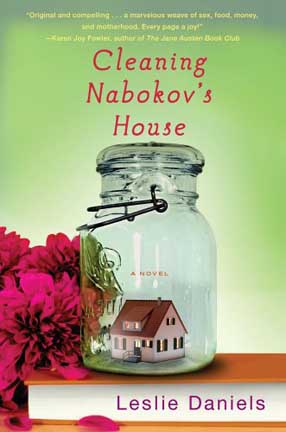
Cleaning Nabokov’s House


Leslie Daniels' debut novel, Cleaning Nabokov’s House (336 pages, Touchstone, $24), is an odd mixture of a work of literary fiction and an unadulterated romance. The heroine Barb, newly divorced, seems barely able to keep herself fed and dressed before she finds herself able to buy a house in an upstate New York college town, where she soon discovers an odd manuscript that might have been written by Vladimir Nabokov, who lived in the house while he taught at the College for a short time.

The manuscript, which is a kind of fantasy about Babe Ruth, fascinates Barb and starts to pull her out of her desperate funk.

She does not feel bad about choosing to leave her husband, but his well-connected local charisma allows him to keep her two children, and this drives her crazy. She is hoping that the money from the Nabokov might give her the money she needs to get her children back.

Of course, she also needs a stable home, and as she starts to come out of her depression, the home starts to feel anything by stable. For one thing, she decides, after a trip to New York where she sees the door of a notorious “cathouse,” to open a male brothel in her town. She poses as a sex-researcher, and gets local strapping college boys to function as her staff. Then she spreads the word for desperate housewives who would like a break in their daily grind. This male “cathouse” becomes so popular that she almost gets in trouble. Her few friends spend all their time urging her to be careful.

Meanwhile, she has fallen, romance-style, for a handsome and well-built local carpenter, Greg. Barb dates Greg gingerly, as if all men are poisonous; but at the same time she does want him to know about her brothel. This creates a bit of narrative amusement, and Daniels is good at playing these two plots against each other.

When the Nabokov connection falls through, Barb’s agent Maggie, the wife of another friend, urges her to try writing romance. She resists at first but gradually she gets the bug and starts to make a success of romance novel writing.

All this time, she is fighting to get her kids. Whether or not that works, when she is involved in running a brothel, is part of the delight of the book. The court-room battle between her and her ex-husband is one of the high points of the narrative.

Leslie Daniels has written an amusing first novel.


Leslie Daniels

Cleaning Nabokov's House is available at Powell's, Vroman's and Amazon.

Monday, September 19, 2011

Alan Hollinghurst captures the twentieth century in a masterpiece of literary recollection.

I have had an early look at this novel that has just been published in England, and I am going to write a longer review than usual.


The Stranger’s Child


Alan Hollinghurst’s The Stranger’s Child (448 pages, Knopf, $27.95) is a staggering accomplishment. It follows the fortunes of a couple of aristocratic families over the course of the twentieth century; and in doing so it raises issues about love and sexuality, memory, family, literary recollection, truth and falsity, bibliography, biography, English culture, war memoirs, and most important, perhaps, poetry and its relation to experience.

The story is told in several set-pieces, ranging from 1913 to 2008. Many of the same characters circulate in each of these pieces, but each features a new character and a new narrative perspective best suited to the historical moment being examined.

Each section of the novel is so riveting and so beautifully told that one could be forgiven for wishing that Hollinghurst had allowed himself to make an entire novel out of this setting or that historical moment. But in the end, it is perfectly clear that all these sections are necessary to tell the story that Hollinghurst is trying to tell. It is nothing less than a kind of cultural analysis of the twentieth century from a number of different perspectives.

At first the story might seem over-familiar. Two Cambridge undergraduates appear at one of their family homes during a vacation time. They are intellectually exuberant, each being a member of the Cambridge Apostles, a secret group that met regularly to discuss ideas and (it seems) to grope each other meaningfully. Cecil and George are in love with each other, and during their visit to George’s home “Two Acres,” they practically scandalize George’s sixteen-year-old sister Daphne, who always has a way of peeking through the hedge just when they are at their most intimate. Cecil Valence is handsome and muscular, and he is domineering as well. George, blond and handsome himself, is utterly smitten; and the two men can hardly keep their hands off each other at dinner or while lying in a hammock.

Meanwhile, Daphne is intrigued with Cecil too. She knows him because of the poetry he has published. He seems a close second to Rupert Brooke at the time—Hollinghurst publishes enough of Cecil’s poetry to allow us to judge for ourselves—and he has astonishing self-assurance. George and Daphne Sawle are caught up in this phenomenon, and both feel that the poetry he writes in Daphne’s autograph book—a poem called “Two Acres”—is meant for them. We have seen enough to know that the love for George was deep and meaningful to the poet but that his dalliance with Daphne—he kissed her in the entryway to the house—was vivid as well. It is fair to say that only George and Cecil know the depth of their shared love, and only they can read between the lines of Cecil’s most famous poem—which “Two Acres” quickly becomes—to understand how richly and fully it represents their love affair.

History, however, sees it differently. Cecil is killed in the First World War, and Daphne claims the role of the woman who was engaged to and now mourns him. It does seem that after the visit to the Sawle house, Daphne went to Cecil’s family house at Corley—a Victorian pile that fascinates her deeply—and that during those visits, apart from the constant carrying on of George and Cecil, she and the poet become attached. She has some love letters from France to prove her attachment. After Cecil’s death, however, she marries his dreadful brother Dudley. The second section of the novel is set in the 1920s, just before the General Strike in England. This is another moment when these upper classes are teetering on collapse. We see Daphne and Dudley at home. They are having a big weekend in celebration of Cecil, and we find other new characters and some of the old ones in new configurations. George is very much in the background here, and so is his mother. But she is carrying around with her a sheaf of letters that Cecil wrote George from France, the male love letters to contrast to those he wrote to Daphne, and she cannot decide whether or not to confront George with them. She is appalled at what they suggest and is clearly torn about what to do with them. We never discover exactly what happens to them, but we get the clear sense that they are lost.

We also hear at this time about some poems that Cecil may or may not have sent from France before his death. Some friends, and especially an early biographer, have seen these poems, but no one is sure what has happened to them.

These two threads—the letters that will tell a fuller truth about Cecil and George and the lost poems of Cecil—come to sustain the narrative, and in a sense we become like literary detectives ourselves, always hoping to get closer to these crucial details.

Throughout several later sections, as these central characters grow older and we meet their children and grandchildren, a young lower class guy, gay himself, gets to know that family and the house at Corley and becomes fascinated with the saga of Cecil Valence, a poet whose work he had to memorize at school. Paul Bryant, a bank teller in the 1960s, is a working biographer by 1980, and we see him trying to piece together the truths of George and Cecil and Daphne back in the teens. He meets the two survivors, the brother and sister who were both in love with Cecil, and talking to them he starts to make sense of the past. Both people are indirect and absolutely confusing when he talks to them, but he still starts to get something of the picture. He is a timid young man, and the sections of the novel in which he is central are among the most fascinating, both because he is an outsider to this upper-class world and because his own sense of himself and what he is trying to achieve is the most tentative.
In the last section of the novel, Paul’s biography has been long-since published, and we hear from various accounts how absurd the family considered it. Cecil was in love with George—what could be more ridiculous—and that Daphne has children outside of her (various) marriages, too. Paul is considered a rank intruder, but we know from our perspective that he has come close to the truth just through his amazing instincts and good guessing.

E. M. Forster is quoted here and seems to be the inspiration for some of the threads of the narrative, especially the early ones concerning the Cambridge Apostles, of which he wrote as well. Later sections, especially those with Paul as the narrative center, remind one most vividly of Henry James’s The Aspern Papers, which also concerned a young man trying to get to the heart of a writers identity. The Stranger’s Child pulls those traditions together, and also makes it clear how faulty memories of the past can be. The eighty-three year-old Daphne may think she is remembering the past, but as she even admits, she can hardly call to mind anything that ever happened after the cocktail hour—some sixty years all blend together in her memory—and who, she tells herself, even remembers anything they read.

This novel is about literature and memory, about attempts to make sense of the past, and how time itself obliterates much of what might in the past have been considered true. As the gay writer tries to get close to what happened in the past, he can only approximate what we ourselves have seen was immensely significant. Hollinghurst has told this story in order to make that fact of literary recollection vivid and meaningful to his readers. In this he has been preeminently successful. This is surely his own literary masterpiece.


Alan Hollinghurst

The Stranger's Child is available at Powell's, Vroman's and Amazon.